
Last week I stood on stage at the Lloyd's Dive In festival in Jakarta, in front of a room full of commercial insurance brokers, and opened with a line that made a few people uncomfortable. Do not deploy AI agents into your brokerage yet.
This year's festival, hosted in Indonesia by APARI, the Association of Indonesian Qualified Insurance and Reinsurance Brokers, carried extra weight. 2026 is the final edition of Dive In, the global festival Lloyd's has run for a decade in support of inclusion across our industry, and I was proud to close it out with a session on where our industry actually stands with AI.
Every broker I speak to right now feels the same pressure. Boards are asking about AI agents. Vendors are selling AI agents. Conferences are full of AI agent demonstrations. And the instinct, understandably, is to buy one and bolt it onto whatever system is already running.
That is the wrong order, and once you see the data behind our industry, it is easy to see why.
The Price Of Inaction
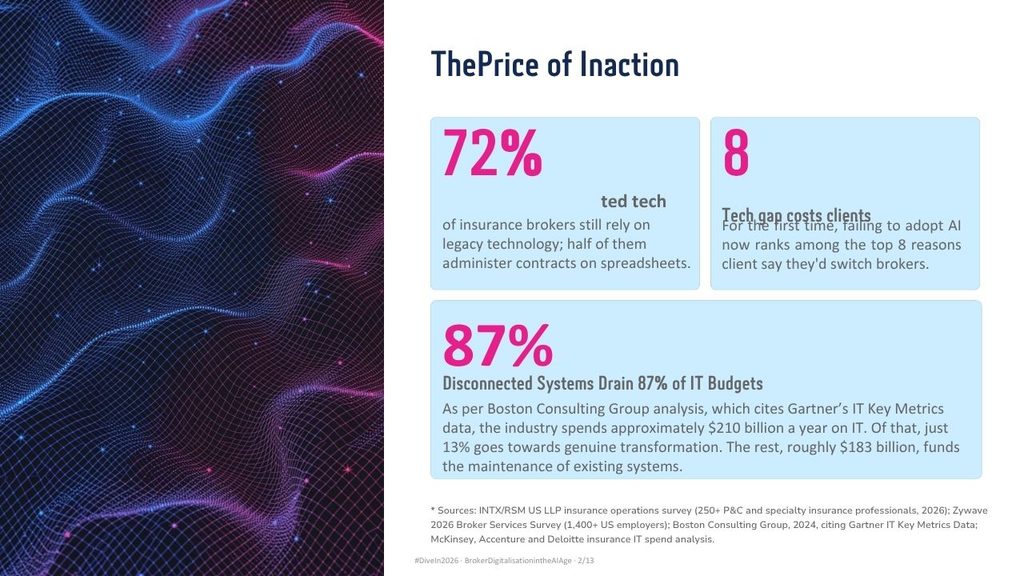
72% of insurance brokers are still running on outdated technology, and half of them are administering contracts on spreadsheets. For the first time, failing to adopt AI now ranks among the top 8 reasons clients say they would switch brokers.
As per Boston Consulting Group analysis, which cites Gartner IT Key Metrics Data, our industry spends approximately 210 billion dollars a year on IT. Of that, just 13% goes towards genuine transformation. The rest, roughly 183 billion dollars, funds the maintenance of existing, disconnected systems.
These figures are not unique to any one broker. They describe an industry that has been running very hard just to stand still, and they explain why the pressure to adopt AI has become so intense so quickly.
The mistake most organisations make next is to treat AI agents as the fix itself, rather than as the last step in a longer piece of work.
Three Pillars For Change
An agent is only as capable as the system underneath it. Drop an AI agent onto a fragmented mix of spreadsheets and legacy software, with no clean data underneath, and the result is a confident, articulate chatbot that cannot actually complete the work a broker needs done.
Before any agent goes live, three pillars need to be in place.
Pillar One - A Modern Broking System
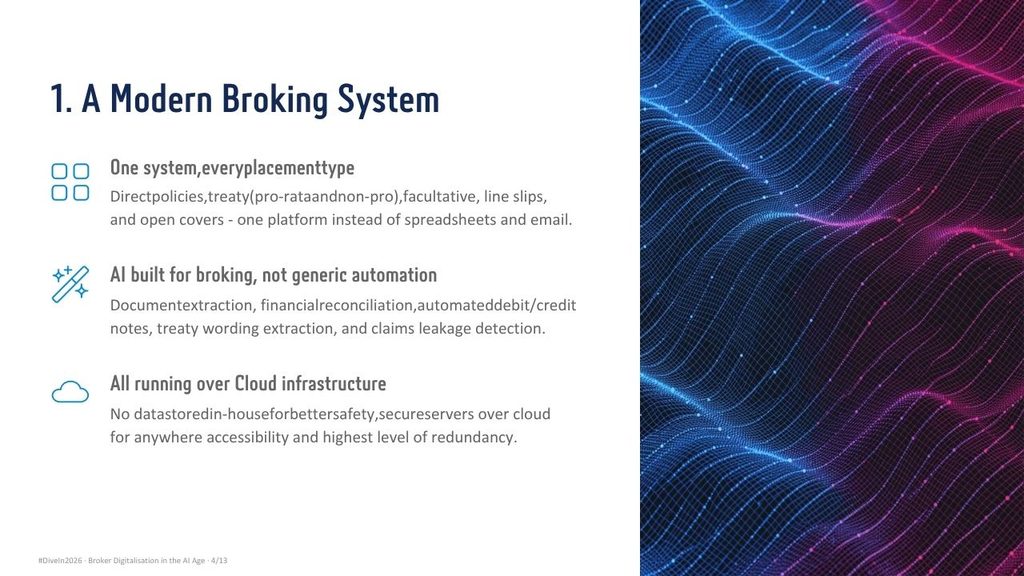
A single unified platform for placements, accounting and reporting. It needs to cover every placement type a commercial broker actually handles, direct policies, treaty business including proportional and non proportional structures, facultative placements, line slips and open covers, replacing the patchwork of spreadsheets and email most brokers still depend on.
Just as importantly, the AI built into this system has to be built for broking, not generic automation borrowed from another industry. Document extraction, financial reconciliation, automated debit and credit notes, treaty wording extraction and claims leakage detection are the kind of tasks that actually move the needle for a broker's operations team.
Pillar Two - A Robust Access Layer
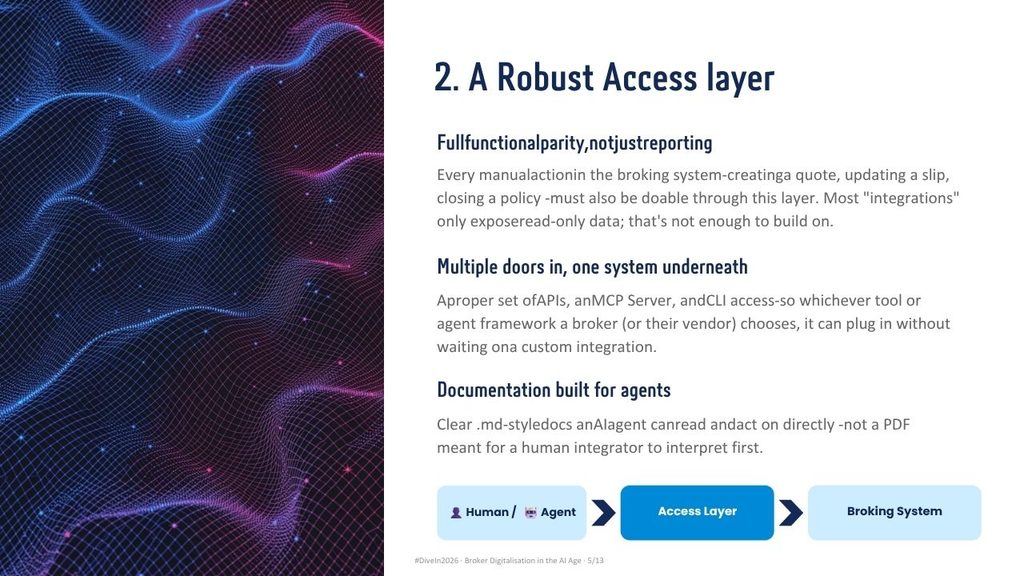
This is the pillar most vendors skip, and it is the one that determines whether an agent can do anything useful at all. Every manual action a person can take inside the broking system, creating a quote, updating a slip, closing a policy, must also be possible through this layer. Most integrations only expose read only data, and read only data is not enough to build an agent on.
A proper access layer offers multiple doors into the same underlying system, a full set of APIs, an MCP Server and CLI access, so whichever tool or agent framework a broker, or their vendor, chooses to use, it can plug in without waiting months for a custom integration. The documentation behind it also needs to be written for machines to read, clear and structured, not a PDF meant for a human integrator to interpret first.
Pillar Three - A Clean Information Infrastructure
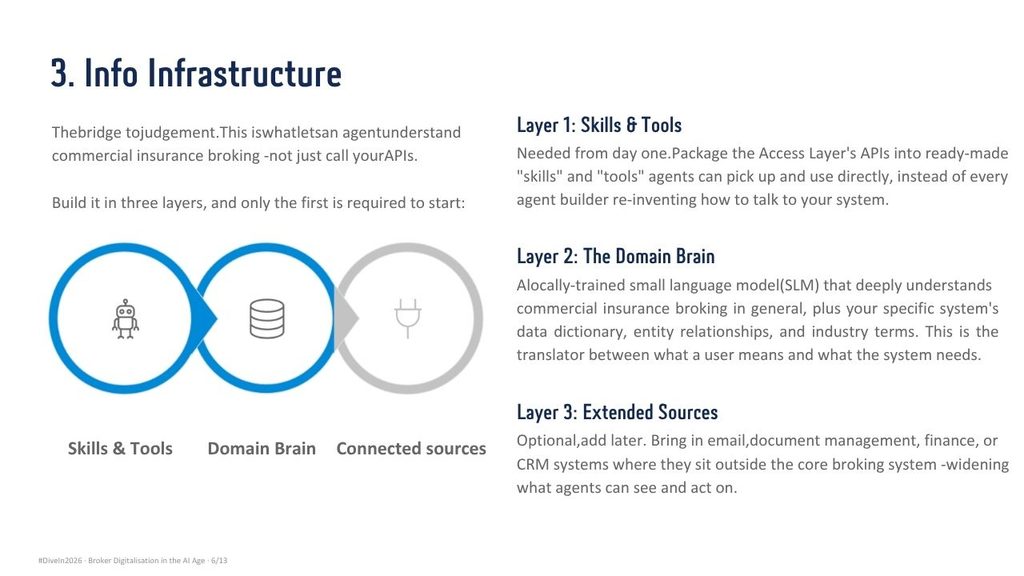
This is the pillar that lets an agent understand commercial insurance broking, not just call an API and hope for the best. We think of it as the bridge to judgement, and it is best built in three layers, with only the first required to start.
Layer one is skills and tools. Needed from day one, it packages the access layer's APIs into ready made skills and tools that agents can pick up and use directly, instead of every agent builder reinventing how to talk to your system.
Layer two is the domain brain. A locally trained small language model that deeply understands commercial insurance broking in general, plus your specific system's data dictionary, entity relationships and industry terms. This is the translator between what a user means and what the system needs.
Layer three is extended sources, optional and added later. This brings in email, document management, finance or CRM systems that sit outside the core broking system, widening what agents can see and act on once the core is solid.
Get these three pillars right, in this order, and deploying agents stops being a leap of faith. It becomes the natural next step, because the foundation is already carrying the weight.
What Is Brokers OS
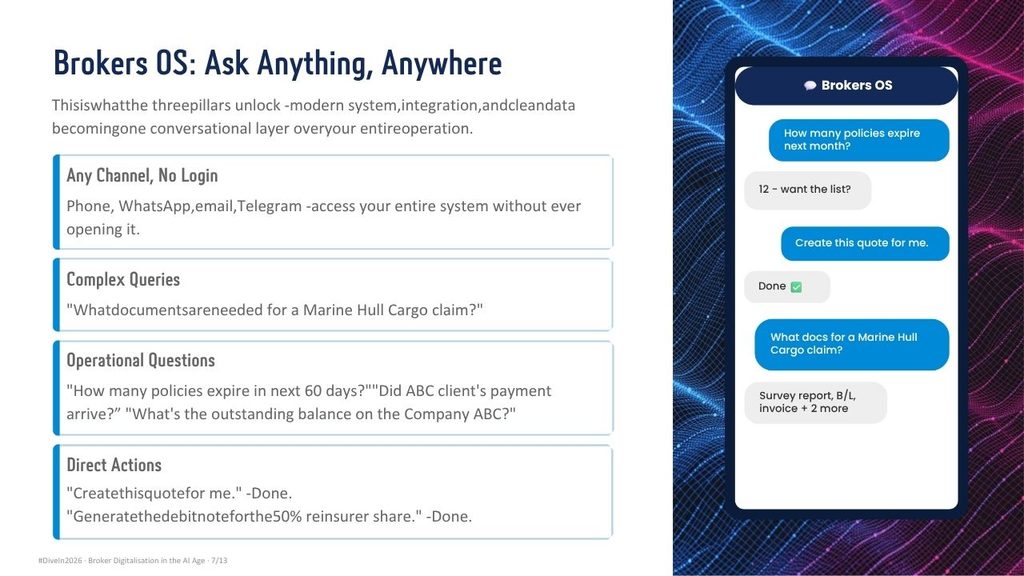
On stage, we showed what we call Brokers OS, a conversational layer that sits across all three pillars at once. A broker can ask, in plain language, over WhatsApp, phone, email or Telegram, a complex question such as what documents are needed for a Marine Hull Cargo claim, or an operational one such as how many policies expire in the next 60 days, and get a real answer pulled from the live system, not a static report.
They can go further and issue direct instructions. Create this quote for me. Generate the debit note for the 50% reinsurer share. And watch the system act on it, without ever opening the underlying application.
None of this is possible without the three pillars underneath it doing their job quietly in the background. That is really the whole point.
Why Most Agentic Projects Fail
Across our industry right now, teams are jumping straight to building agents without establishing the foundation first. They expect magic, but without a modern broking system, an access layer and a clean information infrastructure, an agent has nothing solid to work with.
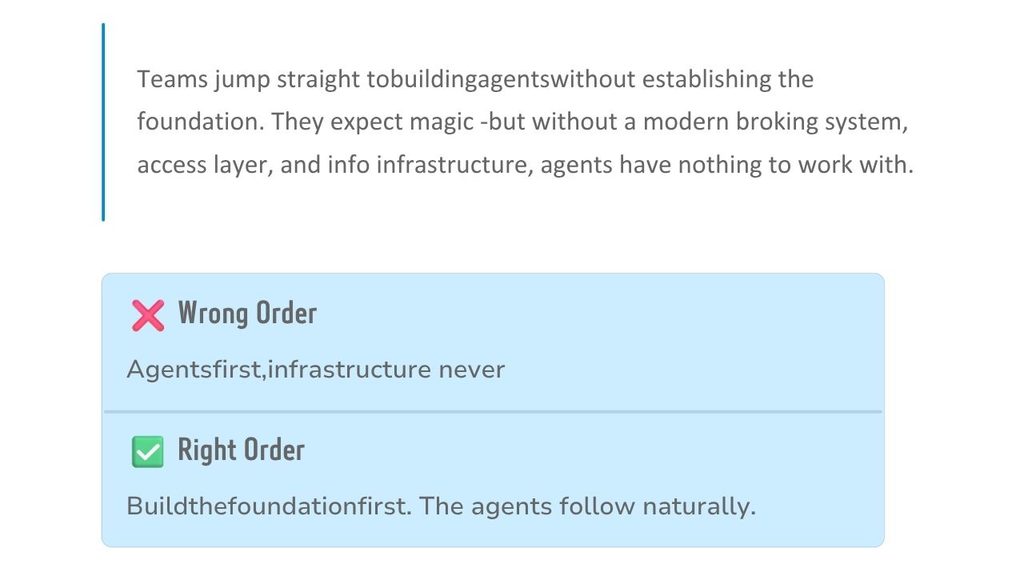
The wrong order is agents first, infrastructure never. The right order is to build the foundation first, and let the agents follow naturally. It sounds simple, and it is, but it is also the single biggest reason agentic AI projects in insurance broking are stalling before they deliver any value.
The Future, One Assistant Per User
Once the foundation is in place, the direction of travel becomes clear. Every placer, operations handler and accounts handler gets their own dedicated assistant, handling their full workload, not a shared chatbot serving the whole office.
From there, teams can spawn specialist sub assistants on demand, one for wording review, another for bordereau reconciliation, another for chasing claims documents, each handling repetitive, high volume work while people approve only when it genuinely matters.
Frequently asked questions
AI native insurance broking describes a broking operation built on a modern system, a robust access layer and a clean information infrastructure from the start, so that AI agents can be added on top as a natural extension, rather than bolted onto legacy technology as an afterthought.
The three pillars are a modern broking system covering every placement type, a robust access layer offering full functional parity for both people and agents, and a clean information infrastructure built in layers, starting with skills and tools, then a domain specific small language model, then optional extended sources.
Most agentic AI projects in insurance broking fail because teams deploy an agent before the underlying system, access and data are ready. An agent dropped onto a fragmented, spreadsheet heavy operation has nothing reliable to act on, so it produces confident answers that are often wrong or incomplete.
A robust access layer is a set of APIs, an MCP Server and CLI access that gives both people and AI agents full functional parity inside a broking system, meaning every manual action a person can take can also be carried out through the layer, not just read only reporting.
Brokers OS is a conversational layer built on top of the three pillars, letting brokers ask questions and issue instructions in plain language over WhatsApp, phone, email or Telegram, and have the underlying broking system answer or act, without needing to open the application itself.
Watch The Full Talk
Download The Presentation Slides
The full slide deck from this talk is available to download below.
See Where Your Brokerage Stands
You do not have to take our word for any of this. There are two low risk steps to see exactly where you stand against the three pillar model, and prove it on your own book of business, before committing to anything.
Step one is an intro and audit session, mapping your current setup against the three pillar model.
Step one is an intro and audit session, mapping your current setup against the three pillar model.
Get in touch at deep@softsolvers.com or visit agiliux.com to get started.
Sources cited
- INTX and RSM US LLP, insurance operations survey, 250 plus P&C and specialty insurance professionals, 2026.
- Zywave, 2026 Broker Services Survey, 1,400 plus US employers.
- Boston Consulting Group, Three Paths To Modernizing Core IT For Insurers, 2024, citing Gartner IT Key Metrics Data 2023.
- McKinsey, IT modernization in insurance, three paths to transformation.
- Genasys Tech, the hidden cost of insurance system integration.
- Lloyd's, Dive In festival, 2026, the final edition.
- APARI, the Association of Indonesian Qualified Insurance and Reinsurance Brokers.

Mohandeep Singh
Mohandeep is the Founder and CEO of Agiliux, the AI-native system of record for mid-market insurance brokers, built to handle multi-country regulatory complexity across Asia.
Deep has spent 26 years building technology businesses, 24 of them as an entrepreneur, most of it at the intersection of software and insurance. Before founding Agiliux, he ran core insurance technology for a major insurtech now part of Bolttech, scaling it across five Southeast Asian countries to 500,000 policies and 15,000 claims a month. He regularly writes and speaks on AI-native insurance platforms, legacy modernisation, and the future of commercial and reinsurance broking.